News
Types of Pleurotus eryngii Strains
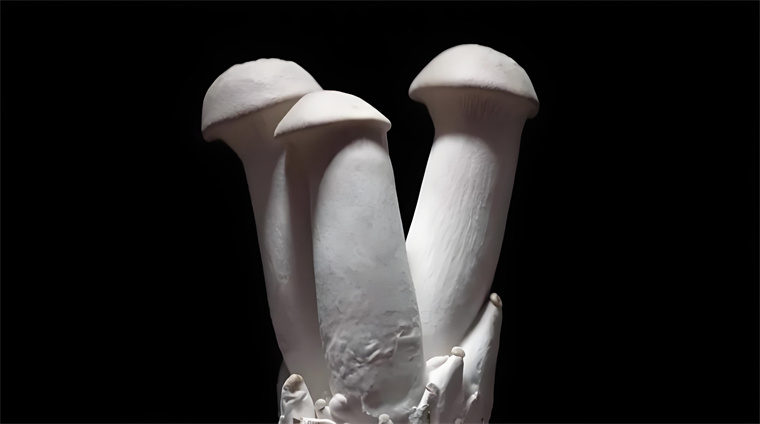
Currently, there are roughly three types of Pleurotus eryngii strains available for commercial cultivation.
1.Club-shaped stalk strain
This strain features a snow-white, uniformly club-shaped stalk that does not swell at the middle or base; it is slender, dense in texture, and offers a crisp, tender mouthfeel with an almond-like aroma and a texture reminiscent of abalone. The cap is light gray and round. While the product commands a high price, has a long shelf life, and is suitable for export, it has a narrow temperature tolerance range (optimal: 10–16°C). Fruiting is relatively slow, the stalks are not particularly thick (typically 2–3 cm in diameter), and yields are relatively low. Temperatures above 18°C make it susceptible to Pseudomonas bacterial infection, leading to crop failure, while temperatures consistently below 10°C inhibit fruiting and cause existing fruiting bodies to wither; successful cultivation requires a strictly controlled temperature range of 10–18°C. This is a domesticated strain derived from wild varieties native to the Mediterranean coast.
2.Bowling-pin-shaped strain
This strain has a white stalk that is swollen in the middle and narrower at the ends, resembling a bowling pin. The fruiting bodies are large but have a loose, spongy texture and lack crispness; the caps range from light brown to gray, and the eating quality is inferior. It is more cold-tolerant than the club-shaped strain, with an optimal temperature range of 8–16°C, and allows for high yields with simple, low-intensity cultivation methods. However, slight temperature increases, poor ventilation, or high humidity make it highly susceptible to Pseudomonas infection, which can contaminate the entire cultivation site and cause crop failure. It has a shorter shelf life and is primarily sold domestically or processed into dried or salted mushrooms; like the first type, it is a domesticated strain derived from wild varieties native to the Mediterranean coast.
3.Selectively bred new club-shaped strain
Characteristics of this strain: The optimal temperature range for cultivation is 8–18°C. When induced to fruit at temperatures of 8–15°C, the mushrooms develop club-shaped stalks that are uniform, thick, and large; the stalks are long and white without basal swelling, resulting in an attractive appearance. However, at temperatures of 16–18°C, the base swells initially before tapering into a slender, uniform shape, resembling a corm. The caps are thick-fleshed and incurved—resisting premature opening—and range in color from light brown to gray; the flesh is dense, offering excellent texture and flavor. This variety is disease-resistant, easy to cultivate, and yields higher than club-shaped or bowling-pin-shaped strains. The produce commands high prices, has a long shelf life, and is well-suited for export. Developed through hybridization or space breeding, this superior strain is highly favored by both growers and the market.
Growers should select varieties based on local climate conditions and market demand, prioritizing strains that offer high yields, excellent flavor, a broad fruiting temperature range, and ease of cultivation and transport.




 Send Email
 WhatsApp