News
Selection of Shiitake Mushroom Strains
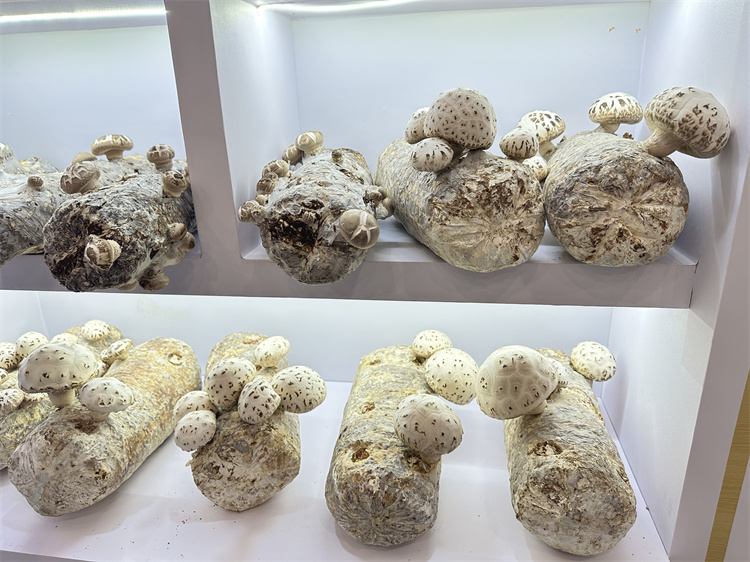
There are many varieties of shiitake mushrooms. Based on fruiting temperature range, they can
be divided into three main categories: high-temperature, medium-temperature, and low-temperature.
High-temperature shiitake mushroom strains have a core fruiting temperature of around 20℃,
medium-temperature strains around 15℃, and low-temperature strains around 10℃. Based on
fruiting body shape, they can be categorized as thick-capped and thin-capped. Based on fruiting body size,
they can be categorized as large-leaf, medium-leaf, and small-leaf. Large-leaf mushrooms have a cap
diameter of 11-15cm, medium-leaf mushrooms 5-10cm, and small-leaf mushrooms less than 5cm.
Based on culture medium adaptability, they can be categorized as log-based, sawdust-based,
or straw-based strains. The quality of the shiitake mushroom strain greatly affects the yield and quality
of the mushrooms. Different shiitake mushroom strains cultivated in the same region using the same
substrate exhibit significant differences in yield and quality; similarly, the same shiitake mushroom strain
cultivated in different regions or in the same region using different substrates also shows substantial
differences in yield and quality. Therefore, it is crucial to select shiitake mushroom strains suitable for local
climate conditions and resources when cultivating shiitake mushrooms.
The standards for high-quality shiitake mushroom strains are as follows:
1. Characteristics of the mother strain: The mycelium is pure white, cottony, robust, and grows in a prostrate,
radial pattern with obvious apical dominance. Aerial mycelium is scarce and short, possessing the characteristic
aroma of shiitake mushrooms. High-quality strains cover the agar slant in 8-10 days at 23-25℃, and secrete a soy
sauce-like liquid droplet in the later stages. As the strain ages, it secretes a slightly yellowish pigment, turning the
culture medium pale yellow. Strains that completely cover the agar slant generally do not form primordia; if
primordia appear, it indicates an early-maturing variety.
2. Characteristics of Primary and Cultivated Spawn: Shiitake mushroom mycelia are white, robust, and uniform,
with a velvety appearance. They do not easily form a thick mycelial covering. They grow vigorously on the bottle
wall in a fan-shaped, feathery pattern, secreting soy sauce-colored droplets with a strong aroma. When cultivated
at 22-25℃, primary spawn bottles typically reach full colony size in 30 days, while cultivated spawn bottles typically
reach full colony size in 40 days.
After the mycelia have fully colonized the bottle, an amber-colored transparent liquid with the characteristic aroma
of shiitake mushrooms is commonly seen within 10-15 days, without any foul or musty odor. If sawdust particles are
visible in the spawn bottle, it indicates insufficient cultivation time, and cultivation should continue for a longer period.
If the mycelial column detaches from the bottle wall, it indicates excessive moisture in the substrate. If the mycelial column
begins to shrink, and the surface mycelial skin thickens and turns dark brown, it indicates that the spawn has begun to age
and is not suitable for use. If a large number of mushroom buds appear, it indicates that the spawn is too old and should not be used.



 Send Email
 WhatsApp